
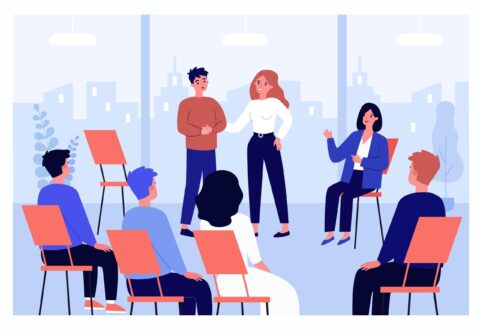
The connection between workplace learning and mental health has never been more apparent. Given that May is Mental Health Awareness Month, I’d like to share some experiences that have made me keenly aware of the importance of learning for mental health and well-being. It begins with a significant shift in attitude that I’ve observed in recent years.
Previously, learning was framed as a performance issue. The latest research (and Redwood’s experience) suggests this view is outdated and points to a direct correlation between mental wellness and our ability to learn and apply the skills required in today’s workplace.
The link between mental health and workplace performance
A recent Canadian workplace mental health study highlights the continuing impact of burnout, stigma, and psychological strain at work. Meanwhile, the World Health Organization notes that poor mental health can affect confidence, social functioning, and participation in workplace activities.
Learning depends on several factors that affect our brain’s bandwidth. We need to pay attention to what matters. We need an agile memory to hold ideas long enough to make sense of them and retain them. We need the ability to regulate emotions and the confidence to attempt the unfamiliar. Equally important, we need the time and space to reflect so that lessons are fully understood.
Why mental health matters for workplace learning
Think of the pressures impacting today’s workforce. Organizations need people to reskill, learn and adapt to AI, and continuously manage a myriad of other changes. Each of these factors creates stress, which invariably narrows attention. And a narrowed attention span makes it more difficult to understand and retain new ideas. All of this translates into poor learner performance.
This is exactly why psychological safety matters so much. When people feel safe asking questions, admitting uncertainty, and having a space to practice and fail without penalty, they learn faster and apply their knowledge more effectively.
Learning projects that continue to build mental health awareness
Over the past few years, we’ve had the opportunity to design and produce several learning projects that have increased the Redwood team’s awareness of this important, often complex issue. For example, we worked with the Canadian Mental Health Association (Ontario) to help trainers and learners understand the 15 psychological factors that affect workplace mental health and safety. You can read about the program in my previous blog.
Another Redwood project, led by the University of Saskatchewan, was part of a toolkit including a free online course. “Connecting for Veteran Wellness” informs service dog organizations about recovery from substance abuse and PTSD.
I mention these projects to illustrate the power of learning in shaping workplace wellness. And the importance of ensuring a psychologically safe and secure workplace environment to maximize learning potential.
So, how do you create a workplace conducive to super learning? Here are five ways to make your learning environment more mentally supportive:
1. Create conditions that help learners focus
A psychologically safe environment is essential to optimizing learning potential. This may entail reducing distractions and providing adequate time for learning without impinging on work responsibilities. It is also critical that learners practice new skills without fear, embarrassment, or blame. The result is a workplace where people use their energy to improve rather than to protect themselves.
2. Provide psychological and social support
Admitting confusion, making mistakes, and “trying it again” in front of coworkers requires a culture of strong psychological and social support. Honesty and non-judgmental support help people feel safe when asking for help, receiving feedback, or closing learning gaps. Treat learners with respect instead of criticism, and they’ll turn challenges into accomplishments!
3. Clearly define roles and expectations
Learners need to understand what is being asked of them, how they will be supported, and what success looks like. When people know the boundaries, responsibilities, and purpose of the training, they are free to focus on learning. Clarity reduces anxiety, builds trust, and gives people the confidence to participate fully.
4. Frame confusion as a natural learning stage
Don’t mistake confusion for failure; it’s often the moment when the brain is working hardest and about to make the desired connections. When you frame confusion as a natural stage, learners are less likely to shut down or feel embarrassed. Instead, they will ask questions, experiment, and persist.
5. Create compelling simulations
Today’s powerful production technologies can supercharge learning by placing people in realistic digital environments. This is especially powerful when practicing difficult interpersonal moments. Because consequences are simulated, learners can make mistakes, replay scenarios, test different approaches, and receive feedback on the quality of their choices.
Psychological safety and wellness are essential conditions for people to learn and grow with confidence. When organizations support workplace well-being, training becomes a catalyst for performance and learning growth. And that makes our work all the more rewarding!